What is Light Intensity and How is it Used?
- Home
- Grow Lights
- Light Intensity
Light Intensity as a Measurement of How Much Light a Plant Needs
All gardeners understand how important light is for plant growth. Plants simply can't live without it, but different plants thrive in different amounts and types of light. You've probably noticed how seed packets give some vague description as to the light requirements of plants, like "place in full sun" or "place in partial shade". In hydroponics, you could keep your grow lights on for 14-16 hours a day, and you would get decent results with most plants. However, if you want to take your hydroponic setup to the next level, you could consider investing in a light meter for plants so that you can provide your plants with just the right amount of light.
Measuring Light Intensity
When it comes to plants' lighting needs, there are two important things to consider: light intensity (how strong the light is) and light amount (how many hours). Light intensity is measured in a unit called lux. Lux is equal to one lumen per square metre. You can measure light intensity using a lux meter. They are not too expensive. You can buy a decent one for £50-100.
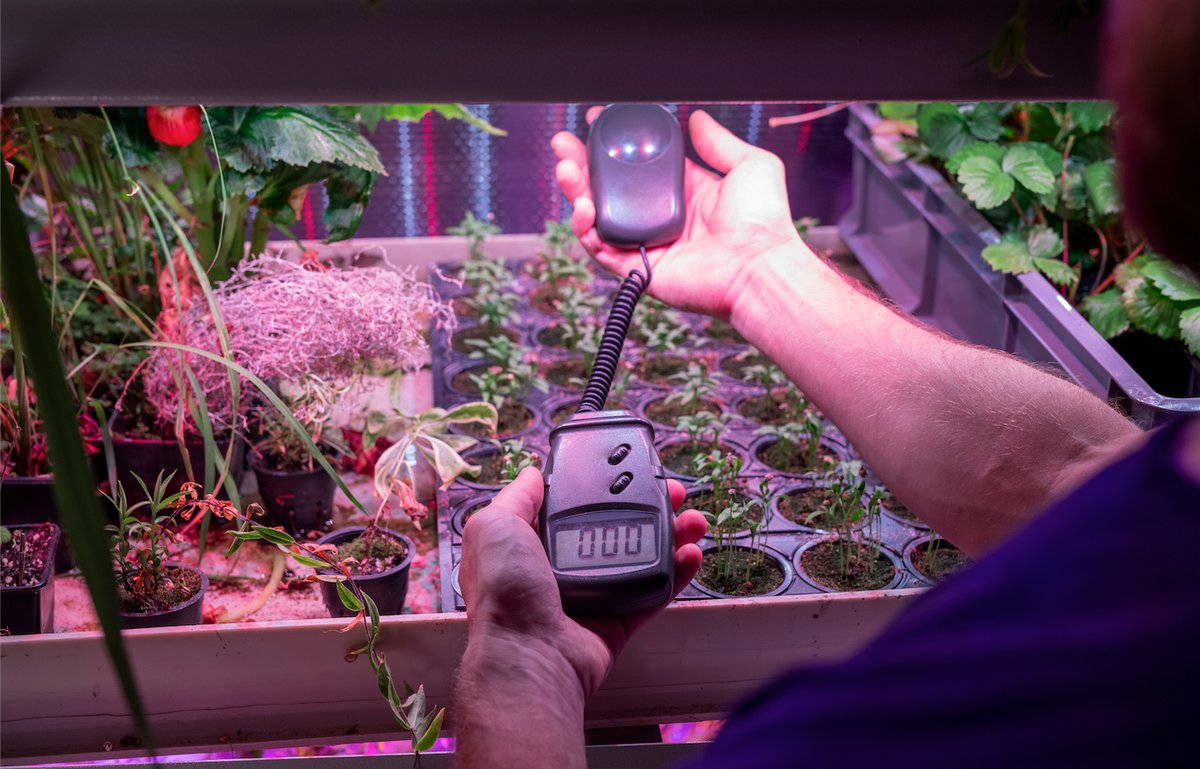
To measure light intensity with a lux meter, first of all you would need to ensure it is properly calibrated according to the manufacturer's instructions. Once you've done that, position your lux meter at the plant's canopy level to get an accurate reading. Allow the reading to stabilise, then record the lux value displayed on the meter.
Below you will find optimal light intensity and light amount values for different plants:
| Plant | Light Intensity (Lux) | Light Amount (Hours) |
|---|---|---|
| Lettuce | 10,000-15,000 | 14-18 |
| Tomatoes | 15,000-35,000 | 14-18 |
| Beans | 6,500-13,000 | 14-16 |
| Peas | 6,500-13,000 | 14-16 |
| Cucumbers | 13,000-26,000 | 12-14 |
| Peppers | 13,000-26,000 | 14-18 |
| Courgettes (zucchini) | 17,000-28,000 | 14-16 |
| Strawberries | 17,000-26,000 | 14-18 |
| Basil | 9,500-22,000 | 14-18 |
| Dill | 13,000-26,000 | 14-16 |
| Mint | 8,500-17,000 | 14-16 |
| Oregano | 13,000-26,000 | 14-18 |
| Parsley | 8,500-17,000 | 14-18 |
| Rosemary | 13,000-26,000 | 14-18 |
| Sage | 8,500-17,000 | 14-16 |
| Thyme | 13,000-26,000 | 14-16 |
Put your lux meter at the top of the plants, type in the reading and how many hours a day the light is on, and I'll check it against the table above.
Lux is a rough guide because it measures light for eyes, not leaves. The daily light figure underneath is an estimate for a white LED; sunlight and HPS convert differently. If you have a PAR meter, trust it over this.
Reading low? Before you buy a bigger light, check the hanging height: half the time the light is just too far away.
Plant-Available Light
When you measure light using a lux meter, you measure what's called "visible light"; however, for plants to perform photosynthesis, they need light within a narrow range of wavelengths between 400 and 700 nanometres long. This range (or spectrum) is called photosynthetically active radiation, or PAR for short.
Different wavelengths represent different colours of visible light. This particular range goes from dark blue at 400 nanometres to dark red at 700 nanometres. Most photosynthesis in plants occurs in the PAR ranges that are blue, orange and red. That's why "blurple" LED grow lights are so popular. They are cheaper than full-spectrum LED lights because they only use diodes in specific wavelengths that are most usable by plants. Whether or not they are the best type of grow lights is debatable, but they are definitely efficient and can be a good choice if you want to save some money compared to full-spectrum LED lights. They are not as versatile, however, and are not the best for starting seeds, for example.
The amount of usable PAR light that actually arrives at the plants is measured in PPFD, or photosynthetic photon flux density. You can measure the amount of PAR with a PAR/PPFD meter. This device calculates the density of photons within the PAR spectrum contacting a specific area every second.
The measuring process is essentially the same as using a lux meter. Make sure your PAR meter is properly calibrated according to the manufacturer's instructions. Then position it at the plant's canopy level to get an accurate reading. Allow the reading to stabilise, then record the PPFD value displayed on the meter.
Depending on the plants you grow and their growth stage, the optimal amount of PAR can range from 100-400 PPFD (blue light) in the seedling stage to 700-1,200 PPFD (red/orange light) for flowering plants, which is why you would start your plants with MH grow lights (which produce blue light) and then switch to HPS grow lights (which produce warmer red/orange light) if you don't have full-spectrum LED lights which work equally well at all growth stages.
One email a month from me, Charlie. What is new on the site, one grower’s question answered properly, and the latest video. No spam, no selling.


I’m Charlie, co-founder of Everything Hydroponics. I’ve completed an official qualification in hydroponic cultivation, I run the Everything Hydroponics YouTube channel, and I’ve advised and taught many new and existing growers. I’m a teacher at heart, so what you read here is backed up by peer reviewed research and presented in a digestible way. Most of my growing time now goes on chillies. More about Charlie
You might like these
Do Hydroponic Plants Need Sunlight?
All plants require sunlight don't they? Do hydroponic plants need sunlight? How do they get sunlight if they are grown indoors? Read here for all the answers!
What is a Ceramic Metal Halide Grow Light?
There are a variety of different lights that are suitable for use in hydroponics, including metal halide lights. But what is a ceramic metal halide grow light?
Simple DIY Grow Light Shelves Project
Are you on a budget? Or perhaps you are just looking for a custom solution to your light shelf problems? DIY grow light shelves are a great option!