The Best Indoor Herb Grow Light for You
- Home
- Grow Lights
- Herb Grow Lights
If you're looking for an indoor herb grow light for your hydroponic system, you've come to the right place. In this guide, I'll cover the light requirements for growing herbs indoors and what types of grow lights work best for growing herbs indoors. Hopefully, it will help you choose the right indoor herb grow light for your system.
People often take up hydroponics because they want to grow their own food, but they don't have outdoor space for a garden. When growing indoors, it's important to match the natural sunlight requirements for your plants. This can easily be done by using grow lights.
Outdoor gardens require around 8 hours of direct sunlight per day. Most herbs need between 6 and 8 hours of sunlight per day. Herbs taste stronger the more light they get, so it's important to provide enough light for your herbs when growing them indoors. Artificial lighting for a hydroponic garden provided by grow lights should imitate the direct and indirect lighting requirements for your plants. Different plants have different needs, but for most herbs you'll need to provide 12 hours of artificial light, followed by 12 hours of darkness.
Choosing indoor herb grow lights for your hydroponic garden can be a daunting task, as there are a lot of different options on the market. For herbs, fluorescent and LED grow lights work best. Metal halide (MH) and high-pressure sodium (HPS) grow lights produce too much heat and can burn your herbs. The pros and cons of fluorescent and LED grow lights will be covered below to help you choose the right indoor herb grow light for your hydroponic garden.
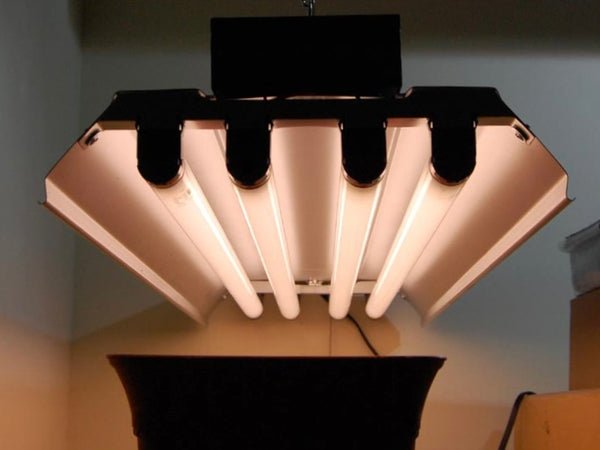
Fluorescent grow lights are great for growing herbs indoors because they produce very little heat and are also highly energy efficient. They can also be used for starting seeds and growing lettuce, salad greens, and flowers. There are two types of fluorescent grow lights: compact fluorescent grow lights (CFL) and T5 fluorescent grow lights. Both of them have their own benefits and drawbacks, which will be discussed below.
T5 fluorescent grow lights look like tubes. T5 comes from two attributes of these bulbs: they are tubular (T) and they have a 5/8" diameter (5), hence the designation T5. T5 fluorescent grow lights usually come in an array of bulbs that are arranged parallel to each other in lighting fixtures containing multiple bulbs. T5 grow light fixtures can be quite bulky, so if you have limited space, compact fluorescent grow light might be a better choice for you.
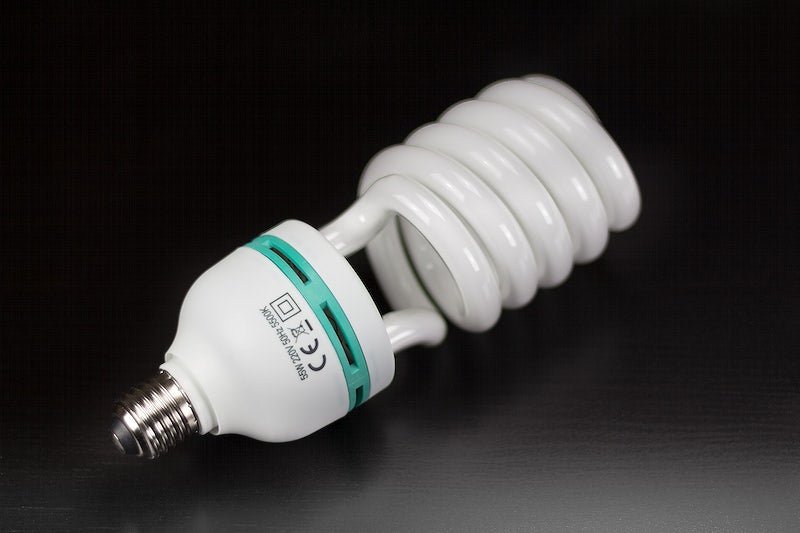
Compact fluorescent grow lights look like energy-efficient bulbs you would use at home, and they use a typical bulb socket. They come in a variety of colours and different wattages. Due to their compact shape and size, you can place them in interesting ways and deliver light to parts of plants that would typically be shaded. You can use a lighting fixture, or you can provide individual sockets for bulbs and arrange them in a way you see fit. I would recommend using reflectors because otherwise a lot of light would be pointed away from plants. Compact fluorescent grow lights can fit in small spaces, so if your growing area is not that large, compact fluorescent grow lights might be a great choice for you.
Fluorescent grow lights are cheaper than LEDs; however, LED grow lights have a few benefits over fluorescent grow lights.
LED grow lights are more energy-efficient and produce more lumens per watt, so a compact LED grow light can produce more light than a bulky fluorescent light. They also have longer lifespan than other types of grow lights and don't lose effectiveness over time. Full-spectrum or RGB LED grow lights are more versatile because they can produce any colour of light, so you can use them to grow plants from seed to harvest. LED grow lights come in different shapes, sizes, and wattage, which makes them suitable for nearly any hydroponic garden.
Both fluorescent and LED grow lights work well as indoor herb grow lights. If you're only growing herbs, then fluorescent grow lights are a great choice for you. However, if you're growing different vegetables and fruits, then they can benefit from full-spectrum LED grow lights because they can provide a more balanced white light that imitates sunlight. While the initial cost will be higher when purchasing LED grow lights, they are really versatile and energy-efficient and will pay for themselves with time.
Grow Light Wattage
A rule of thumb is to have 25-50 watts per square foot of grow space. This means a 1000-watt LED grow light can cover 20-40 square feet. The efficiency of your lighting system is the key to increasing the wattage. LED grow lights are the most efficient lights, and a 500-watt LED light can provide equivalent ratings to a 1000-watt MH or HPS light.
Grow Light Distance to Plants
How high you should have your grow lights above your plants depends on the type of lights you have. I'd suggest following the height recommendations provided by the light manufacturer. However, if that information isn't provided, fluorescent grow lights should be kept 2-3 inches (5-7.5 cm) above plants, and LED grow lights should be at least a foot (30 cm) above. You'll need to move your grow lights away from the plants as they grow.
One email a month from me, Charlie. What is new on the site, one grower’s question answered properly, and the latest video. No spam, no selling.


I’m Charlie, co-founder of Everything Hydroponics. I’ve completed an official qualification in hydroponic cultivation, I run the Everything Hydroponics YouTube channel, and I’ve advised and taught many new and existing growers. I’m a teacher at heart, so what you read here is backed up by peer reviewed research and presented in a digestible way. Most of my growing time now goes on chillies. More about Charlie
You might like these
Do Hydroponic Plants Need Sunlight?
All plants require sunlight don't they? Do hydroponic plants need sunlight? How do they get sunlight if they are grown indoors? Read here for all the answers!
What is a Ceramic Metal Halide Grow Light?
There are a variety of different lights that are suitable for use in hydroponics, including metal halide lights. But what is a ceramic metal halide grow light?
Simple DIY Grow Light Shelves Project
Are you on a budget? Or perhaps you are just looking for a custom solution to your light shelf problems? DIY grow light shelves are a great option!