Nutrient Film Technique
- Home
- Hydroponic Systems
- Nutrient Film Technique
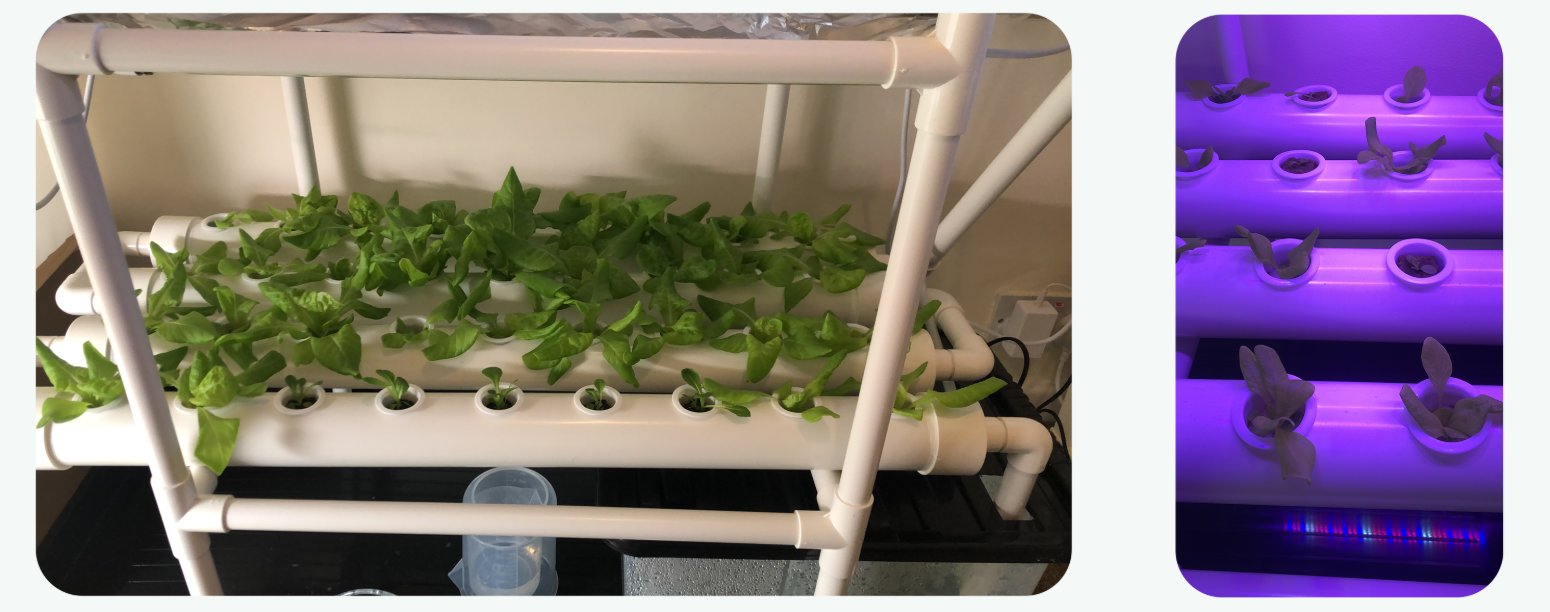
The nutrient film technique or 'NFT' hydroponic system can appear complex at first glance but is actual fairly simple to understand in concept.
It consists of angled channels on which plants sit with their exposed roots freely hanging in the channel cavity below
Water is then pumped down the channels and it flows over the plants' roots providing them with the nutrition they need to grow.
How do Nutrient Film Technique Systems actually work?
The key feature of a nutrient film technique system is the constantly flowing supply of nutrient-rich water. The channels that supply the roots with water are slightly angled, so the water itself is always flowing and moving, creating a thin nutrient "film". This means that the water can provide a constant supply of fresh nutrients as well as remain oxygenated. Just like people, plants also need oxygen to perform respiration and provide themselves with the energy they need to grow.
As far as the mechanics of the nutrient film technique system go, there are a number of moving parts to consider... well one specifically, the water pump.
Nutrient film technique systems are completely reliant on a water pump to circulate the nutrient solution around the system. It effectively acts like the heart of the system, so if it stops, your plants will die. It's therefore imperative that measures are put in place to ensure this doesn't happen, more on that later.
The flow rate of the water is also significant to consider. This represents the amount of water that passes through the system within a specified time frame. Too fast and the plants may not receive enough nutrition, too slow and there is a risk of overnutrition, oxygen deprivation, and the buildup of algae and bacteria.
The gradient or slope of the channels plays a significant role in determining the flow rate. But the size of the roots and other factors also alter the flow rate of the water so there is no one size fits all answer to the correct gradient and flowrate.
I've done some research and here are a selection of interesting studies that delve into the relationship between channel gradient, flow rate, and plant growth within NFT systems
I've understood the general universal flow rate to be around 1-2 l/m (litres per minute), but wanted to get some concrete data to support this.
A good point of reference is Allen Cooper’s “ABC of NFT” (1996). The book is hard to come by, but Hoocho on YouTube has a great video on it.
The following articles all investigate the effect that flow rate has on the efficacy of NFT-style systems, covering a variety of different plants.
The Effects of Slope and Channel Nutrient Solution Gap Number on the Yield of Tomato Crops by a Nutrient Film Technique System under a Warm Climate
- This study highlights the difference in effectiveness of NFT channel gradients at different temperatures
Salinity and flow rates of nutrient solution on cauliflower biometrics in NFT hydroponic system
- This study tests the effect of salt levels and flow rate on the development of cauliflower and concludes that the most effective flow rate is 1.5 l/m.
Head lettuce production and nutrition in relation to nutrient solution flow
- This study focuses on NFT lettuce cultivation and concludes that 1 l/m produced the highest shoot production.
Optimum flow rate enhances the performance of lettuce (Lactuca sativaL.) in hydroponic culture
- This study covers NFT systems growing lettuce and concludes that 1.5 l/m is the best flow rate and that yield decreased as the flow rate headed further towards 2 l/m.
Effect of Flow Rate and Length of Gully on Lettuce Plants in Aquaponic and Hydroponic Systems
- This study covers an aquaponic system using an NFT gully and focuses on optimal gully length and flow rate.
- It concludes that the optimal gully length was 2 m and 1.5 l/m was the optimal flow rate.
Hydroponic lettuce production in different concentrations and flow rates of nutrient solution
- This study focuses on ionic concentration and flow rate when growing lettuce in an NFT system and concludes that 1.5 l/m was the best flow rate with 100% ionic concentration.
- This study doesn't explicitly specify the system it was covering but it can be presumed that it is referring to systems with NFT style construction.
- It covers the growth of Swiss chard and concludes that between 2-4 l/m growth increased, but any higher than 4 l/m began to show a comparative decrease in growth
- This study uses a variety of flow rates in an NFT system growing lettuce and concludes the most effective to be 20 l/h or 0.33 l/m.
- This was surprisingly lower than I would have expected.
Effect of the Flow Rate on Plant Growth and Flow Visualization of Nutrient Solution in Hydroponics
- This study is also focuses on Swiss chard but highlights how flow pattern as well as flow rate is important in understanding how to best utilise NFT style systems.
- It concludes that a 6 l/m flow patter is best for this crop but not for all crops.
- This study uses a virtual model of an NFT system to analyse flow rate and concludes that "litres per minute" is not the best metric when measuring how effective water flow is, and that "Raynolds number" should be used instead.
- "Raynolds number" measures flow pattern as opposed to rate, and takes into account the complexities of water dynamics within a pipe interior filled with net pots.
Conclusion
So as you can see there are a number of different ideas surrounding what the ideal flow rate is for optimal NFT system efficacy as well as discussions on whether l/m (litres per minute) is even a useful measurement when discussing this.
That said it is clear to see that among these studies a flow rate between 1-2 l/m does appears a number of times.
A limitation of this analysis is that most of the studies above are using lettuce or greens. It is important to remember that different crops will always differ from one another and that there is ultimately no one-size-fits-all solution.
You will always have to test and tweak as you go depending on multiple factors but a flow rate of 1-2 l/m is definitely a good place to start!
Video Guide for Getting Started with Nutrient Film Technique

One email a month from me, Charlie. What is new on the site, one grower’s question answered properly, and the latest video. No spam, no selling.


I’m Charlie, co-founder of Everything Hydroponics. I’ve completed an official qualification in hydroponic cultivation, I run the Everything Hydroponics YouTube channel, and I’ve advised and taught many new and existing growers. I’m a teacher at heart, so what you read here is backed up by peer reviewed research and presented in a digestible way. Most of my growing time now goes on chillies. More about Charlie
You might like these
Deep Water Culture: Build A DWC System From A Storage Box
Deep water culture suspends roots in aerated nutrient solution. It needs very few parts, and this is how to build one and why it suits a first system.
Ebb And Flow Hydroponics: How Flood And Drain Systems Work
Ebb and flow floods the roots then drains them, because not every plant likes sitting in water. How the system works, and how to build one.
Wick System Hydroponics: The Simplest System To Build
A wick system draws solution up into the medium with no pump and nothing to fail. What it suits, what it cannot keep up with, and how to build one.